
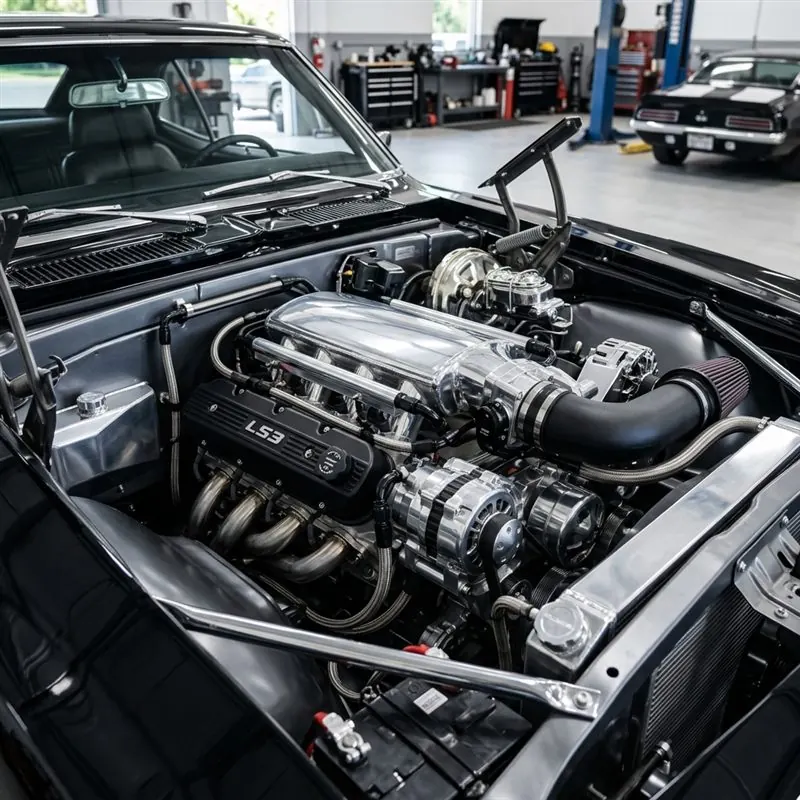
Coyote vs LS swap � which is the better engine for your classic car? In the world of custom street rods and pro-touring restomods, two high-performance V8 engine families reign supreme: the GM LS Crate Engine series (LS3, L99, LT1) and the Ford 5.0L Coyote V8 (Gen 1, 2, and 3). Both engines offer modern electronic fuel injection, 430+ horsepower out of the box, spin turn-key reliability, and outstanding aftermarket support.
However, dropping a modern high-revving V8 into a 1967 Ford Mustang Fastback, 1969 Chevrolet Camaro SS, or 1932 Ford Deuce Coupe involves completely different engineering challenges. From engine bay width and shock tower clearance to wiring harnesses, oil pan sumps, and turn-key budgets, our master engine builders at Carolina Street Rods LS Swap Shop provide an honest, unbiased comparison to help you choose the right powerplant for your garage build.
- 1. Physical Size & Shock Tower Clearance Comparison
- 2. Horsepower, RPM Limits & Power Delivery Curves
- 3. Wiring Harness & Control Pack Installation
- 4. Transmission Pairing (Tremec T56 vs 10R80)
- 5. Turn-Key US Build Cost Comparison
- 6. Final Verdict: Which Engine Fits Your Build?
- 7. Frequently Asked Questions
1. Engine Architecture & Physical Size Comparison
The most significant engineering difference between the Ford 5.0L Coyote and the GM LS3 lies in their cylinder head architecture and physical valve train dimensions:
GM LS Architecture (Pushrod OHV - Overhead Valve):
The GM LS engine family relies on a compact pushrod design with a single camshaft positioned deep inside the engine block, operating 16 overhead valves via pushrods and rocker arms. Because it lacks bulky cylinder head camshaft assemblies, an LS engine is remarkably compact — measuring only 20.5 inches wide from valve cover to valve cover. This narrow physical envelope allows an LS3 to drop seamlessly into tight vintage engine bays (such as a 1967 Chevrolet Camaro, 1955 Chevy pickup, or 1932 Ford Deuce Coupe) without cutting body sheet metal, inner fender walls, or steering linkage clearancing.
Ford Coyote Architecture (DOHC - Double Overhead Camshaft):
The Ford 5.0L Coyote is a modern engineering marvel featuring 4 valves per cylinder, dual overhead camshafts per bank (4 cams total), and Twin Independent Variable Cam Timing (Ti-VCT). However, housing four camshafts requires massive cylinder heads. The Coyote measures a staggering 29.0 inches wide and 27.0 inches tall. That makes the 5.0L Coyote nearly 9 inches wider than an LS3 and wider than a vintage 429 Ford Big Block engine!
⚙️ Fitment Reality: Mustang Shock Tower Clearance
If you are swapping a Coyote 5.0L into a 1965–1970 Ford Mustang, 1960–1965 Ford Falcon, or 1932 Ford street rod, the massive 29-inch engine width requires cutting out the factory front shock towers and installing a Mustang II style independent front suspension (IFS) kit or Heidts notch subframe.
2. Power Curves: Low-End Torque vs High-RPM Screamer
On the street or autocross track, the two powerplants deliver contrasting driving dynamics:
GM LS3 6.2L V8 (430 HP / 425 lb-ft Torque):
Thanks to its large 376 cubic inch engine displacement, the LS3 produces instant low-end grunt — generating 350+ lb-ft of torque starting at just 2,200 RPM. This wide torque plateau makes an LS3-powered restomod feel light on its feet during daily driving, pulling hard in 6th gear at 70 MPH without needing downshifts. Peak horsepower arrives at a manageable 5,900 RPM with effortless throttle response.
Ford Gen 3 Coyote 5.0L V8 (460 HP / 420 lb-ft Torque):
The 307 cubic inch Coyote thrives on engine RPM. As variable valve timing advances cam timing at higher engine speeds, the Coyote comes alive — pulling relentlessly all the way to an exhilarating 7,500 RPM redline. While it produces slightly less off-idle torque than a 6.2L LS, it delivers an intoxicating, high-pitched mechanical exhaust note resembling a European supercar.
3. Master Engine Comparison Matrix
| Engineering Spec | GM LS3 6.2L Crate V8 | Ford 5.0L Coyote Gen 3 V8 |
|---|---|---|
| Valve Train Architecture | Pushrod OHV (16 Valves, Single Cam) | DOHC Quad-Cam (32 Valves, Ti-VCT) |
| Displacement | 6.2 Liters (376 cu. in.) | 5.0 Liters (307 cu. in.) |
| Stock Crate Horsepower | 430 HP @ 5,900 RPM | 460 HP @ 7,000 RPM |
| Peak Torque Output | 425 lb-ft @ 4,600 RPM | 420 lb-ft @ 4,600 RPM |
| Physical Engine Width | 20.5 Inches (Compact fit) | 29.0 Inches (Requires wide bay) |
| Engine Weight (Aluminum) | 415 lbs (Fully dressed) | 445 lbs (Fully dressed) |
| Standalone ECU Harness | Holley Terminator X MAX ($1,250) | Ford Controls Pack ($1,950) |
| AVERAGE TURNKEY SWAP COST | $8,500 - $11,500 | $13,500 - $17,500 |
4. Standalone Wiring & Control Electronics
Operating a modern fuel-injected engine with drive-by-wire electronic throttle control in a vintage car chassis requires a dedicated standalone engine management system:
Ford Performance Controls Pack (Coyote):
Ford simplifies Coyote swaps by offering factory-engineered Ford Performance Controls Packs specific to Gen 1, Gen 2, or Gen 3 5.0L engines. Each package includes a factory-flashed Powertrain Control Module (PCM), drive-by-wire gas pedal harness, dual wideband oxygen sensors, mass air flow sensor tube, and a pre-wired power distribution relay box. Installation requires making four basic chassis connections: 12V Switched Ignition, 12V Battery Constant, Electric Fuel Pump output, and Ground.
Holley Terminator X MAX (LS Swap):
For GM LS swaps, the Holley Terminator X MAX system is the gold standard in hot rod fabrication shops. Featuring real-time self-learning fuel injection tuning, high-speed closed-loop oxygen sensor control, and integrated electronic transmission control (for 4L60E or 4L80E automatics), the Terminator X eliminates the need for expensive custom dyno tuning during initial startup. Its built-in CAN-bus output connects seamlessly to digital dash clusters like the Dakota Digital RTX series over a single data cable.
5. Transmission Pairing, Cooling & Chassis Oil Pan Clearances
Plumbing power to the rear differential requires matching your engine choice with transmission tunnel space, accessory drives, and oil pan sumps:
Manual Transmission Options:
Both engine families pair effortlessly with the Tremec T56 Magnum 6-speed or the compact Tremec TKX 5-speed. The TKX features rounded case corners designed to slip into tight 1960s transmission tunnels without needing floor metal cutting. QuickTime manufactures SFI-approved steel safety bellhousings for both GM LS and Ford modular bolt patterns.
Automatic Transmission Options:
LS swaps pair seamlessly with electronically controlled GM 4L60E or heavy-duty 4L80E 4-speed automatics. Coyote swaps pair with the Ford 10R80 10-speed automatic overdrive, though the 10R80 transmission case is physically wide and requires widening the vehicle's floor tunnel. Alternatively, a Ford 4R70W 4-speed automatic offers a compact, easy-fit alternative.
Oil Pan Sump & Steering Rack Clearance:
OEM factory oil pans rarely clear vintage steering center-links or front crossmembers. LS swaps utilize Holley 302-2 or 302-3 retro-fit cast aluminum oil pans, which provide 1.25 inches of additional front crossmember clearance. Coyote swaps require specialized rear-sump conversion oil pans from Moroso or Canton Racing equipped with thick silicone pan gaskets.
Radiator Cooling & Steam Bleed Plumbing:
Both engines require dual pass aluminum radiators equipped with high-CFM electric fan shrouds. The GM LS engine requires plumbing an LS steam bleed vent hose into the upper radiator hose or water pump port to prevent air pockets inside the cylinder heads. The Coyote requires a pressurized coolant expansion tank to maintain system pressure at high RPM.
6. Turnkey Financial Cost Breakdown & Final Verdict
When calculating a complete turn-key engine swap — factoring crate engine purchase, standalone control harness, accessory drive kit, oil pan, exhaust headers, aluminum radiator, fuel tank EFI pump, and shop installation labor — an LS swap typically costs $4,000 to $6,000 less than a Coyote swap due to lower parts pricing and simpler engine bay fitment.
The Builder's Decision Rule of Thumb:
- Choose the GM LS3 V8 if: You want maximum horsepower per dollar spent, immediate low-end torque, compact engine bay fitment without cutting shock towers, and endless aftermarket parts options.
- Choose the Ford 5.0L Coyote if: You are building a high-end Ford vehicle (1965–1970 Mustang, F-100 truck, or 1932 Ford coupe), insist on brand loyalty purism, and want a 7,500 RPM high-revving exotic V8 exhaust note.
Ready for Your Engine Swap Upgrade?
Whether you choose a 500HP GM LS3 crate engine or a high-revving Ford 5.0L Coyote V8 conversion, the custom hot rod builders at Carolina Street Rods deliver turn-key, dyno-tested installations guaranteed to turn heads. Browse our hot rods for sale and street rods for sale inventory, or get a custom engine swap quote.
📚 Related Articles You Should Read
- LS Swap Guide for Classic Cars: The Complete Blueprint — Ready to commit to the LS platform? Dive deep into motor mounts, fuel delivery, wiring harnesses, and garage budgets.
- How Much Does a Custom Street Rod Build Cost in 2026? — Get the complete financial picture with our 3-tier cost matrix covering $35K DIY builds to $300K show cars.
- Digital Dash Installation Guide for Classic Cars — Once your engine swap is done, connect Dakota Digital RTX gauges via CAN-bus for accurate readings from your Holley or Ford ECU.
❓ Frequently Asked Questions: Coyote vs LS Swap
Is the Ford Coyote 5.0 bigger than an LS3?
Yes, significantly. The Ford Coyote 5.0L DOHC is approximately 3.5 inches wider and 2 inches taller than a comparable LS3 due to its dual overhead cam (DOHC) valve covers. This extra width means the Coyote does not fit in many classic engine bays without shock tower notching or custom inner fender modifications. The LS3's pushrod design gives it a narrower, more compact profile that drops into most pre-1972 vehicles with minimal fabrication.
Which makes more power: Coyote or LS?
In stock form, the Gen 3 Coyote 5.0L produces 460 HP versus the LS3's 430 HP — a 30 HP advantage for Ford. However, the LS platform responds dramatically better to forced induction. A basic turbo LS3 on pump gas can produce 650+ HP for under $5,000 in additional parts. Achieving equivalent power from a Coyote requires more expensive supporting modifications (intake manifold, fuel system, PCM tuning) due to the DOHC architecture.
Is a Coyote swap more expensive than an LS swap?
Yes. A complete Ford Performance Coyote crate engine with controls pack costs $8,500 to $12,000. A comparable LS3 crate from GM or a Holley Connect & Cruise package runs $6,500 to $9,000. Additionally, Coyote swap kits (motor mounts, oil pans, headers) are produced by fewer manufacturers, which limits price competition and increases component costs by 20-40% versus LS equivalents.
Can I put a Coyote in a Chevy Camaro or Chevelle?
Technically yes, but it requires significant custom fabrication. The Coyote's wider DOHC heads conflict with GM shock towers and steering boxes. Companies like Sikky Manufacturing make Coyote swap kits for select GM platforms, but expect $3,000 to $5,000 in additional motor mount and oil pan components versus a bolt-in LS swap. Most builders choose Coyote swaps for Ford-bodied vehicles (Mustang, F-100) where the engine bay width is already designed for a wider powerplant.
Which engine sounds better: Coyote or LS?
This is entirely subjective, but each engine has a distinctive character. The Coyote 5.0 has a high-revving, European sports car scream that peaks at 7,500+ RPM — closer to a Ferrari than a traditional American V8. The LS produces the classic deep, rumbling V8 tone with a lopey camshaft that hot rod enthusiasts expect. At Carolina Street Rods, clients who want the traditional muscle car sound universally choose LS. Clients who want a unique, attention-grabbing exhaust note gravitate toward the Coyote.
Written by the Carolina Street Rods Engine Shop
Experience with Both Ford Coyote & GM LS Engine Platforms
Our engine shop has completed both Coyote and LS swaps in classic vehicles, giving us hands-on perspective that most single-brand shops cannot offer. Every dimension, clearance measurement, and cost figure in this comparison comes from actual builds — not manufacturer marketing. Contact us to discuss which engine is right for your classic.