
How much does a custom street rod build cost in 2026? The first question every automotive enthusiast asks when starting a custom project is: "How much is this build actually going to cost me?" Search online automotive forums and you will find answers ranging anywhere from $30,000 for a DIY garage build to over $250,000 for a professional turn-key pro-touring restomod build.
Why is there such a massive price spread? Because a custom vehicle build is not a single product — it is an accumulation of thousands of component choices and hundreds of skilled labor hours. At Carolina Street Rods, we believe in 100% financial transparency. In this guide, we break down real 2026 shop labor rates ($110–$150/hr across NC and FL), chassis engineering costs, engine options, custom paint booth pricing, and the hidden budget traps that cause DIY projects to stall halfway through completion.
- 1. 2026 Custom Build Cost Summary (Tier 1 to Tier 3)
- 2. US Professional Shop Labor Rates & Total Build Hours
- 3. Chassis, Independent Front Suspension & Brake Costs
- 4. Engine & Drivetrain Options (LS3, Coyote, Turn-Key V8)
- 5. Bodywork, Sheet Metal & Show-Quality Paint Costs
- 6. Custom Leather Interior & Wiring Costs
- 7. 5 Hidden Budget Traps to Avoid
- 8. Frequently Asked Questions
1. The Three Build Tiers: Budget vs Pro-Touring vs Ridler Show Car
Before establishing a budget, you must define your vehicle's intended build tier:
Tier 1: The DIY Budget / Weekend Driver ($35,000 – $55,000 Total)
Built primarily by the owner in a home garage with select shop sublet work (such as paint or upholstery). Utilizes a stock modified chassis, a junkyard 5.3L LM7 engine swap, reworked factory wiring, 15-inch vintage wheels, and driver-quality acrylic urethane paint. Total professional labor hours: 100 to 250 hours.
Tier 2: Professional Pro-Touring Restomod / High-End Street Rod ($75,000 – $145,000 Total)
The sweet spot for active enthusiasts seeking turn-key reliability and modern performance. Built by a professional shop using an aftermarket Art Morrison or Roadster Shop chassis, a new GM LS3 (500HP) crate engine, Tremec T56 6-speed transmission, Wilwood 6-piston disc brakes, Vintage Air A/C, Dakota Digital RTX gauges, and show-quality base/clear paint. Total professional labor hours: 800 to 1,400 hours.
Tier 3: Concours Ridler / Great 8 Show Car ($180,000 – $350,000+ Total)
No-expense-spared engineering aimed at national award competition (Goodguys Street Rod of the Year or Detroit Autorama Ridler Award). Features one-off billet wheels, custom hand-hammered sheet metal body modifications, flush-fit glass, polished independent rear suspension (IRS), hand-stitched Italian leather interior, and a 1,000-hour mirror paint finish. Total professional labor hours: 2,000 to 3,500+ hours.
2. Itemized Component Cost Matrix (2026 Market Pricing)
| Build Component Category | Tier 1: DIY Budget | Tier 2: Pro-Touring Restomod | Tier 3: Ridler Show Car |
|---|---|---|---|
| Donor Car / Body Shell | $5,000 - $12,000 (Project body) | $15,000 - $28,000 (Solid vehicle) | $25,000 - $45,000 (Dynacorn steel shell) |
| Chassis, Suspension & Brakes | $2,500 (Stock rebuild + disc swap) | $16,500 (Art Morrison chassis + Wilwood) | $32,000 (Custom IRS frame + Brembo carbon) |
| Engine & Transmission Package | $3,500 (Used 5.3L + 4L60E) | $14,500 (LS3 crate + T56 6-speed) | $35,000 (Supercharged 800HP LSA / Nelson) |
| Bodywork & Sheet Metal Labor | $4,000 (Basic patch panels) | $18,000 (Full rotisserie media blast) | $48,000 (Custom metal fabrication) |
| Show Paint Booth & Polishing | $5,500 (Single-stage urethane) | $16,500 (PPG base/clear mirror finish) | $38,000 (Glasurit custom candy, 600h sand) |
| Interior, AC & Gauges | $3,000 (Stock kit + sensor gauge) | $12,500 (Leather + Vintage Air + Dakota) | $28,000 (Full custom leather & 3D console) |
| Wiring, Fuel & Assembly Labor | $2,000 (Basic harness & tank) | $11,500 (Holley EFI + Tanks Inc + Assembly) | $25,000 (Custom hidden wiring + Plumbing) |
| ESTIMATED TOTAL BUILD COST | $35,500 - $53,000 | $104,500 - $137,500 | $231,000 - $319,000+ |
3. The Labor Factor: Where 1,200 Professional Shop Hours Go
In high-end automotive restoration and restomod fabrication, component costs only tell half the financial story. Professional shop labor billing at $110 to $150 per hour accounts for 50% to 60% of the overall invoice. Below is a detailed breakdown of where skilled craftsman hours are invested during a typical 1,200-hour pro-touring restomod build:
Phase A: Disassembly, Cataloging & Media Blasting (40 – 60 Hours)
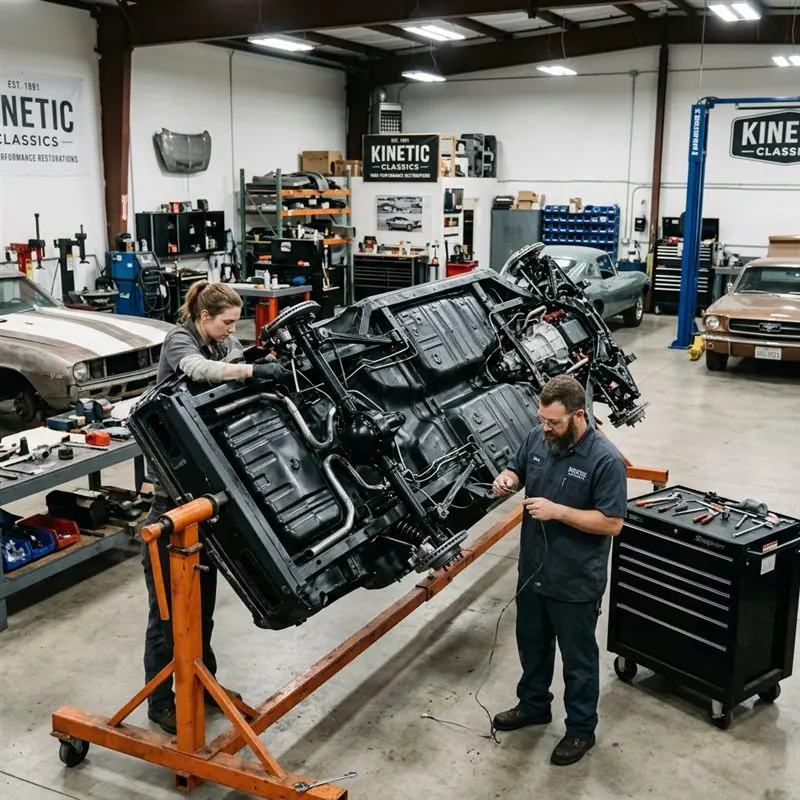
Every bolt, trim clip, and glass channel must be removed, cataloged, and stored in tagged containers. The bare steel body shell is mounted onto a rotisserie fixture and transported for plastic bead or crushed glass media blasting to strip 50 years of old paint, undercoating, and hidden rust.
Phase B: Metal Fabrication, Rust Repair & Chassis Mockup (150 – 300 Hours)
Rarely does a 50-year-old vehicle body arrive without rust damage. Fabricators cut out oxidized floor pans, rocker panels, and quarter panels, butt-welding fresh 18-gauge steel sheet metal. Mini-tubs are welded into rear wheel wells to accommodate 315-width rear tires, firewalls are smoothed for engine bay aesthetics, and aftermarket Art Morrison or Roadster Shop chassis frames are test-fitted and squared on a frame jig.
Phase C: Body Prep, Epoxy Priming & Block Sanding (250 – 400 Hours)
Body preparation is the most labor-intensive phase of any build. Metal panels receive 2 coats of anti-corrosive epoxy primer, followed by high-build polyester primer. Technicians hand-block sand the entire body using long sanding boards through progressively finer grit paper (180, 320, 400, and 600 grit) to eliminate panel waves, setting perfect 3/16-inch door, hood, and trunk gaps.
Phase D: Paint Booth Application & Wet Sanding (100 – 160 Hours)
Inside a heated downdraft spray booth, technicians apply 3 coats of base color (such as PPG Vibrance or Glasurit candy red) followed by 4 coats of premium high-solids clear coat. After curing, the entire vehicle undergoes wet sanding from 1200 grit up to 5000 grit, followed by 3-stage rotary wool and foam pad polishing to achieve a flawless, mirror-like depth.
Phase E: Final Mechanical Assembly, Wiring & Shakedown (180 – 280 Hours)
Final assembly requires painstaking care so newly painted surfaces are never scratched. Technicians install the LS3 crate engine, Tremec T56 transmission, Wilwood brake lines, Vintage Air climate system, Holley EFI wiring, glass, weatherstripping, and custom leather upholstery. The vehicle then undergoes 100+ miles of road testing and chassis dyno tuning to eliminate squeaks, calibrate gauges, and optimize fuel curves.
4. The 5 Hidden Costs Most Builders Oversights
⚠️ Budget Trap Warning: The "Unseen 20%" Expenses
When calculating a build budget, always reserve a 15% to 20% contingency fund for these five commonly overlooked expenses:
- Chrome Re-Plating & Brightwork Polishing ($2,500 – $6,500): Restoring pitted original pot metal bumpers, grille surrounds, and window trim is labor intensive.
- Custom Tempered Glass & Weatherstripping ($1,500 – $3,500): Replacing 50-year-old scratched glass and installing new molded rubber seals.
- Freight Shipping & Parts Delivery ($1,500 – $3,000): LTL truck freight charges for heavy crate engines, chassis frames, and body panels.
- Chassis Dyno & ECU Tuning ($600 – $1,500): Professional dyno session to calibrate air-fuel ratios, timing, and transmission shift points.
- DMV Title, Bonded Inspection & Registration ($500 – $1,200): Out-of-state title transfers, VIN verification inspections, and state sales taxes.
5. How to Prevent Cost Overruns: The Milestone Shop Agreement
To prevent budget bloat, unexpected scope creep, or project delays when contracting a professional custom build shop, insist on establishing a formal Milestone Shop Agreement before releasing your initial deposit. A professional agreement incorporates four essential builder protections:
- Itemized Phase Estimate Breakdown: Require the shop to structure your build into 5 distinct phases (Phase 1: Disassembly & Media Blasting, Phase 2: Metal Fabrication & Chassis Mockup, Phase 3: Body Prep & Paint Booth, Phase 4: Assembly & Wiring, Phase 5: Dyno Tuning & Shakedown). Progress payments should only be released upon completion and inspection of each milestone phase.
- Bi-Weekly Photo & Labor Hours Logs: Ensure your agreement specifies bi-weekly digital progress reports. The shop must supply high-resolution photos documenting completed sheet metal work, chassis fitment, and electrical wiring alongside itemized labor hour receipts before issuing subsequent invoices.
- Written Change-Order Approval: Hidden rust or component lead times often require adjustments during a build. Establish a strict policy requiring signed, written Change-Order forms detailing parts cost and labor hours before any non-estimated fabrication work begins.
- Agreed Value Parts Ownership: Ensure all uninstalled crate engines, aftermarket chassis frames, and custom body panels purchased with your deposits are contractually designated as client-owned property with clear serial number logging.
Get a Transparent Build Consultation for Your Project
Planning a custom street rod build, LS swap engine conversion, or pro-touring restomod? Contact the custom hot rod builders at Carolina Street Rods for an itemized build consultation and transparent financial roadmap. You can also buy custom street rod chassis packages, browse our hot rods for sale, or shop classic cars for sale in our inventory.
📚 Related Articles You Should Read
- Restomod vs Restoration: Which is Right for Your Classic Car? — Not sure which build path to take? Our detailed comparison helps you decide between factory restoration and modern restomod upgrades.
- LS Swap Guide for Classic Cars: The Complete Blueprint — Understand exactly what goes into the engine swap portion of your build budget with our complete technical walkthrough.
- Top 10 Street Rod & Classic Car Events in 2026 — Planning to showcase your finished build? Check out the biggest car shows and rod runs across the Southeast.
❓ Frequently Asked Questions: Street Rod Build Costs
Is it cheaper to build or buy a street rod?
Buying a finished street rod is almost always cheaper than building one. A turn-key show-quality build that costs $120,000 to $180,000 to construct typically sells for $80,000 to $130,000 on the secondary market. You build a street rod because you want a specific machine tailored to your vision — not as a financial investment. If budget is the priority, buying a completed build from a reputable dealer like Carolina Street Rods saves significant money.
What is the single most expensive part of a street rod build?
Professional labor and bodywork/paint consistently represent the largest cost category — typically 35% to 45% of the total build budget. A show-quality paint job with full body preparation (blocking, seam sealing, panel gaps) alone can cost $15,000 to $40,000. The second-largest expense is the chassis and drivetrain combination. A complete Art Morrison chassis with suspension runs $12,000 to $25,000.
How long does it take to build a street rod from scratch?
A professional shop building full-time typically completes a ground-up street rod in 12 to 18 months. Complex show-car builds with extensive custom fabrication can take 24+ months. DIY garage builders working evenings and weekends should expect 3 to 5 years for a comparable quality level. The most common delay is waiting for parts — backordered body panels, custom upholstery, and specialty plating can add 2 to 4 months.
Can I finance a custom street rod build?
Yes. Companies like Woodside Credit, JJ Best Banc, and Lightstream offer specialty auto loans for classic car purchases and builds. Interest rates for classic vehicles typically range from 5.99% to 8.99% APR with terms up to 180 months. Some shops (including Carolina Street Rods) offer phased billing where you pay in milestones — chassis completion, body/paint completion, and final assembly — which makes budgeting more manageable.
What hidden costs should I budget for in a street rod build?
The most commonly overlooked costs include: shipping the donor car ($1,500-$3,000), media blasting for rust assessment ($800-$2,000), wiring harness labor ($2,000-$4,000), title and registration fees for modified vehicles ($200-$500), specialty insurance during the build ($400-$800/year), and brake upgrades to match increased engine power (Wilwood 4-piston kits run $1,800-$3,500). Always budget a 20% contingency buffer above your estimated total.
Written by the Carolina Street Rods Build Team
25+ Years of Transparent Build Pricing & Project Management
Every dollar figure in this guide comes from real invoices, actual parts pricing, and documented shop labor rates from Carolina Street Rods builds completed between 2020 and 2026. We believe in transparent pricing — no hidden fees, no scope creep surprises. Request a detailed build estimate for your project.